

Only a few local towns have sought state O.K.
By Connie Paige
The Boston Globe
BOSTON, Mass. — In an incident a year ago, three Raynham police officers struggled to arrest a 20-year-old man who allegedly had abused his girlfriend.
A Taser X26 stun gun is displayed at the Oakland Country Sheriff’'s office in Pontiac, Mich., Dec. 2006. (AP Photo/Carlos Osorio) |
Matthew Hayes ordered the police out of his apartment, screaming obscenities and flailing his arms. The noise awoke neighbors, who crowded outside in the hallway.
“I’'m going to Tase you!” warned officer Michelle Mills, but Hayes ignored her, according to the police incident report filed later in court.
“Taser! Taser! Taser!” Mills shouted, and shot Hayes in the abdomen with a 50,000-volt electrical charge.
Hayes was handcuffed and charged with assault and battery, resisting arrest, and disorderly conduct.
The outcome is proof enough for Raynham Police Chief Louis Pacheco that Tasers belong among the essential equipment issued to police.
Raynham is one of three south suburban police departments that have received state clearance to carry the devices. The others are Rockland and Norton, and Foxborough is expected to join them; a Town Meeting there just approved $37,000 in next year’'s budget to purchase Tasers, pending state approval.
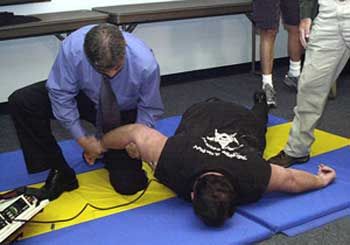 Orange County, Fla. Sheriff Kevin Beary is held by Dr. Louis Rueda, left, as he falls to the floor after being hit with a taser gun at the Orange County Sheriff’'s Training Facility in 2004. Beary invited the media to the event as part of the training given to members of the Taser Review Committee. (AP Photo/Peter Cosgrove) |
“They’'re a great, great, great tool,” Pacheco said last week.
Not all local police chiefs agree.
The varying views reflect a nationwide debate over the weapons. Many believe Tasers can subdue unruly suspects more safely than guns, nightsticks, or pepper spray. Still, some suspects have died after being subjected to them, giving rise to a fear of lawsuits. Another complaint is that, despite their steep price tag, Tasers don’'t always work.
“We are not going to carry them or use them at the Quincy Police Department while I am the chief,” said Chief Robert Crowley. “I think they’'re too dangerous.”
Many police departments have been eyeing the purchase of Tasers since 2004, when a new state law permitted their use, subject to the approval of the state Executive Office of Public Safety. The law requires police departments to record the time and reason for the use of a Taser, and the race and gender of the person zapped. The reports must be filed quarterly with the state.
Tasers have been a hot commodity for years. Since 1998, Taser International Inc., headquartered in Scottsdale, Ariz., has sold 225,000 Tasers to 11,000 law-enforcement agencies, and 125,000 units to private citizens in the United States, according to an e-mail message from Steve Tuttle, the company’'s vice president of communications. Tuttle did not say how many had been sold in Massachusetts.
The device utilizes a replaceable cartridge containing compressed nitrogen to deploy twin probes attached to the gun by wires. The probes, resembling barbed fish hooks, can travel about 35 feet and transmit electrical pulses of about 50,000 volts. The energy can penetrate up to two inches of clothing.
The shock can cause a person to lose muscle control within seconds -- a reaction that Pacheco said causes less long-term harm to the subject than other control methods. “This gives the officer another option,” he said.
In 2005, Pacheco himself agreed to take a zap from a Taser to show that the device causes no serious harm. He said he believes that swayed Town Meeting to approve his purchase of 12 of the weapons.
The department now has 22 officers who carry Tasers, out of 26 trained to use them, according to the latest quarterly report filed with the state.
Pacheco said the police have used the device at least three times, including in the Hayes arrest. About a year ago, officers also fired one to subdue a motorcycle gang that got out of control, he said. And last month, when a patient at a local treatment facility had a seizure and fought off help from emergency medical technicians, police used it again, he said. Pacheco declined to provide the date of the incident or the name of the patient because of privacy laws.
Incidents involving people with preexisting medical conditions are, in part, what prompted the human rights group Amnesty International to examine whether Tasers are being used appropriately. An Amnesty International report issued in March 2006 said that at least 152 people had died in the United States since June 2001 after being shocked with the device.
The report found what it said were troubling results in cases involving people under the influence of drugs or medication, or who were subjected to multiple or prolonged shocks.
“The numbers of people who have died in Taser-related incidents have continued to grow,” Joshua Rubenstein, Amnesty’'s Northeast regional director, said last week. “We are still waiting for fully independent, comprehensive medical testing.”
While the federal Food and Drug Administration requires testing on pacemakers and electroshock therapy, he said, Tasers receive no such scrutiny.
“I think everybody should start asking why,” he said.
But Tuttle, speaking for the weapon’'s manufacturer, called the Amnesty report a “game of numbers,” and said Tasers are safer than other methods “to halt violent situations that pose a safety risk to an officer, suspect, or innocent citizens.”
Tuttle said an updated Amnesty number of 232 deaths in the United States and Canada was culled mostly from media reports.
The “unscientific methodology used by Amnesty International is to count any in-custody death involving [an] electronic control device . . . while conveniently failing to update these inflated numbers when the medical examiner exonerates Taser technology,” Tuttle said.
Still, many local police chiefs remain wary of the weapons.
Braintree Police Chief Paul Frazier said he is concerned about potential lawsuits if a Taser causes injuries or death.
While armed robberies, drug-related crime, gang activity, and house burglaries are on the rise in his community, Frazier said he is “not in any rush” to get Tasers.
“I think we do OK with what we have,” he said. “I know it’'s coming, but for right now, I’'d rather use the tools that we have to take on those challenges.”
Other chiefs say the weapons are too pricey, with a cost ranging from $399 to $899 each, according to Tuttle.
“I think they’'re effective, but not cost-effective,” said Hanover Police Chief Paul Hayes.
Cost also is a factor in Rockland, where Tasers have been approved but have not been purchased. Police Chief John Llewellyn said he eventually wants to arm all 34 members of the force with them. Police currently are raising money privately for an initial purchase because the town cannot afford them under a tight budget, he said.
Walpole Chief Richard Stillman said that while he believes Tasers would be a “great asset,” he has other priorities, such as hiring more officers.
Even communities willing to fork over the money for the weapons can find them problematic. In an incident last February in Norton, officers used the stun gun at a local halfway house for drug and alcohol abusers to try to subdue a client described in a police report as drunk and “combative.”
But the Taser had “little to no effect” on the client, the report stated.
Instead, two officers grabbed the man, forced him to the ground, and handcuffed him the old-fashioned way. According to the report, a single Taser barb later was removed from the man’'s skin.
Copyright 2007 Boston Globe