

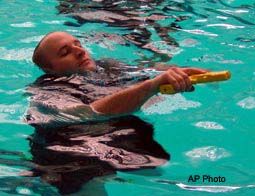
When you think of threats to officer safety, gunfire, edged weapons, physical assaults, car crashes, and even heart attacks generally come to mind. Rarely, however, is drowning on the list. Tragically, three separate officer drownings in just one month stand testimony to this very real, yet rarely discussed officer survival issue.
In May, Border Agent Richard Goldstein drowned while searching an area near the Salton Sea in California, Probation Officer David Poling from Ohio, died in a strong river current while pursuing a suspect and Texas Game Warden Teyran “Ty” Patterson drowned when his boat capsized during a search and rescue operation on a river.
It’s important to remember that it’s not just officers who patrol near major waterfront areas who need to be aware of drowning risks. Anyone who patrols near lakes—big or small—rivers, canals, and pools can also find themselves in water-related danger if unprepared.
Police1 talked to the Founder of Water Based Defensive Tactics and Water Survival Expert Dave Young of Redman Training out of Northcentral Technical College in Wausau, WI, to help shed some light on best practice in waterborne environments.
Here, according to Young, are the top five mistakes officers make when it comes to water safety:
• Overestimating your abilities in the water
• Failing to have a “Plan B” if things go wrong
• Failing to call in your exact location (entry point) at a body of water so back up can find you
• Following a subject you’re pursuing too closely
• Making dangerous assumptions
Overestimating your ability
False self-confidence about your abilities in the water can pose a major threat to your own safety. It is an officer’s responsibility to understand his or her own limitations and act accordingly. This is not like jumping in the pool and swimming all day as a child. One cramp, especially to the limbs — legs or arms — can be life-threatening to an adult, even in average temperature and average depth water.
“Not everyone is buoyant,” said Young. “I have met some people that I place in the “iron duck” category, meaning that no matter what stroke, kick or breathing method they use, they sink.” It’s your responsibility to candidly test your own water abilities and make tactical decisions based on that. If you know you’re an “iron duck,” as Young puts it, don’t chase a suspect into the water. Simple, but life-saving.
Exercises to practice to identify your water abilities:
1. Breathing control – Go to a local pool and see how well you are able to hold your breath and monitor your ability to breath effectively while afloat.
2. Check your buoyancy. Are you able to float well?
3. Identify the arm stroke and leg kick that works best for you in order to tread water and move in the water.
Here’s a practice test: Pick a target goal, say swimming for 30 seconds in your duty gear. If you can’t do it without panicking or having major difficulty, don’t put yourself in a position where you would have to. Remember, swimming and staying afloat in duty gear is tiring and difficult--sometimes to the surprise of an officer who suddenly finds himself in the water--and fatigue is deadly. It can take just 3-5 seconds for a fatigued person to slip under and drown. If you know you’re not proficient performing in the water, don’t set yourself up to be a drowning victim.
Recommendation: Patrol officers who work in a lake/river or high-density pool area should go through an annual water screening in order to test his/her limitations.
Failing to have a Plan B
If your first plan isn’t working, you’ll need a need another one. Say you’re swimming to a drowning subject who is calling for help, but when you grab him, he turns and grabs you, climbs on you and pulls you under the water: Plan A interrupted. Be sure to implement “when/then thinking” in a water environment just as you would on land. “When this person grabs me, then I will…”
Or, again, say you’re swimming back to safety when you start to experience severe cramps that limit your ability continue with the rescue. Will you persevere, or will you make a tactical decision to momentarily let go of the other person and take a breather so you’ll be better able to make a successful rescue, thus potentially saving two lives?
If you enter the water at any time and fail to plan ahead for things that could go wrong, you maybe be jeopardizing your life more than you think.
Failing to call in your exact entry location
Think about your normal routine. When you respond to land-based calls, you clearly identify your street location for back up. You and your fellow officers know the geographical area like the back of your hand. The same protocol must exist when you approach or enter a body of water.
“When you call for back up, give more information than just the name of the lake,” said Young. “Each body of water needs pre-designated markers at points of entry around the perimeter that correspond to a letter.” On a local map, Young further suggests, agencies should mark those points (e.g. dock, boat ramp, swim clearing) so they can be quickly referenced. That way, if you enter the water away from your parked cruiser, your specific point of entry can be better identified by responding officers.
Following too closely to a subject you’re pursuing
A good rule of thumb is to let the subject stay 30 paces ahead of you, giving you time to evaluate what’s ahead—like a drop-off into a lake—and avoid it if necessary. You don’t want to run blindly into the water and find yourself taken off guard and unprepared.
It’s your job to enter the water smartly and safely. Watch the suspect and use him as your barometer for the water conditions and his water-borne abilities. Is he standing, meaning the water is shallow? Is he gasping for air in cold water? Is he swimming like a fish, or struggling to stay afloat? All these things can give you quick insight into what you’ll face if you go in.
Making assumptions
It is deadly to make assumptions in a waterborne environment, where there are hundreds of factors, most of them predictable. “Most people drown because they gauge the water incorrectly,” said Young. They assume it’s shallow when it’s not, or they assume there’s no serious current, when there is.
Another deadly assumption is misjudging distance: You enter the water and get halfway to the victim or person you’re pursuing and realize that you didn’t take the time to really consider how far away they are. Once you’re deep into the water, struggling and suddenly feeling unable to return safely to shore, it could be too late. Don’t blindly assume that you’re going to be able to reach someone. You need to take the time to seriously consider their distance from shore and your ability to get out there and back safely.
Also, if you’re considering going in after a suspect because he claims to be drowning, stay alert to a “water ambush” of sorts. Don’t assume that he’s really drowning just because he’s thrashing around. Stay alert to the possibility that he’s luring you in so he can attack you in the water, hoping you’ll be at a disadvantage.
Rescue considerations
Many officers who die in a drowning accident are trying to help a victim. Officers are very action-oriented, but in cases like this, it can work against them. Your first priority is to not becoming a victim yourself.
To this end, don’t go into the water unless you have to. This goes against the core “rescue now, think later” grain of police officers. But remember, you are the solution to the emergency, you are not the emergency. While it might seem counterintuitive to wait 30 seconds in order to find an object to extend to the victim or to breathe and call for back up, this could save two lives.
In most communities, police are not the designated first response team for water rescue. Generally the EMS and fire folks have more training and equipment for these situations. Therefore, it is up to police departments to reach out to these local experts, to know what resources are available in your community, and to have a plan in place ahead of time. You will not have time to draw up a tactical plan when an emergency is in progress.
That said, when you’re standing on shore (not in the water) look for any available resources. Depending on your surroundings, this may be a life vest, boat, branch, or rope. Take stock. Take the time to think.
Once you engage the victim, communication will be very important. Young recommends the following:
• Stay calm
• Tell them to look at you
• Talk in a professional and positive voice
• Be direct – YOU stay in control
• Establish a dialog
Suspect pursuit considerations
Chasing a fleeing suspect into the water is highly dangerous and before doing so, you should strongly consider your water abilities. Officers can have a tendency to fall into the “I have to catch the bad guy, no matter what” mind-set, but before you decide to follow, you need to take the time to weigh the officer safety risks.
According to Young, two top safety threats when chasing a suspect into the water are:
• Once he hits the water, you can’t see his hands;
• It will be difficult to swim with a firearm in your hand (unless you’ve specifically practiced this skill).
Water behavior and properties
To better prepare for the possibility of needing to function in bodies of water in your area, it is important that officers log all possible information about them. This includes, but is not limited to:
• Water depth
• Undertows
• Currents (open water)
• Flows (water released by man-made sluices or structures)
• Debris on bottom
• Water temperature
• Topography (terrain on bottom)
• Location and types of bridges
• Water entry points
• Wildlife (alligators, snakes, etc.)
Being aware of the characteristics of the water you’re thinking of entering can help you make a smarter tactical decision.
Do I take gear off before getting in the water?
Your duty belt, which weighs in at 18-21 pounds while dry, will be very heavy when it’s waterlogged. But it can be helpful in many situations, and aid the officer in his/her survival.
For instance, it can serve as:
1. A way to secure/access your firearm (Keep your ballistic vest on and place it between your vest and chest)
2. An anchor – something to wedge between, say, you and the dock, if there is a strong current (wrap around piling).
3. An impact weapon.
Of course, it’s not just a duty belt that weighs you down. If an officer weighs 230 lbs., and wearing all of his/her assigned gear then add an approximately 18 lbs., with 20%-30% restricted movement and loss of flexibility. Once in the water and the uniform is submerged, the officer will have anywhere from 30-40 lbs. of added weight, or more based on the type of construction of the vest and duty gear. Knowing how to maneuver with this added bulk and restriction is key to water safety training.