

 |
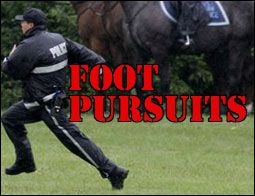
Chasing a suspect on foot—heading straight into a slew of unknowns—is clearly dangerous. Because foot pursuits can lead to significant injuries and even death of both officers and suspects while generating legal liability, it’s obviously best to avoid them whenever possible.
Our Police1 experts will tell you that with the right preparation and proper tactics, you can stop the suspect and stay safe, without ever giving chase. Because of course, the best way to “win” a foot chase is not to have one.The Initial Approach
Your every movement, from approach to apprehension, is critical. According to Dr. George J. Thompson, president and founder of the Verbal Judo Institute, 93% of your effectiveness is your delivery. Your voice, your gestures – everything about your presentation – should be polite and modulated.
“I call it tactical civility,” Dr. Thompson told Police1.com. “If you’re abrupt, if you say, ‘Hey Buddy, get over here!’ you’re warning the subject of what you’re about to do. But if you’re polite, say, ‘Excuse me, let me introduce myself. . .’ he will relax enough to let you get into position.”
“In our society, people tend to equate civility with a low level of threat,” Dr. Thompson says. “Obviously, you intend a great deal of threat, but the evenness of your tone and facial expressions will help keep the subject’s adrenaline in check, while allowing you to take advantage of his lowered guard.”
Many foot pursuits take place because cops come on too strong. So keep your approach cool and collected.
Positioning
It’s your job to make sure that if the subject attempts to run, he isn’t able to escape. Proper positioning of police resources and teamwork by the arresting officers can prevent a suspect from making a break for freedom.
The “contact/cover” principle is very effective for two officers arriving on the scene: One watches, the other acts. Approach the subject by “bracketing,” meaning the cover officer needs to be at a 90º angle to the talking officer. This positioning allows the officers to be able cut off escape routes, avoid possible cross-fire situations, and allows for monitoring a full 360% – covering each other’s back.
“Always be surprising to the suspect,” says Dr. Thompson. “Don’t let them anticipate your next move.”
The Watchful Eye
How do you know if your subject is about to run? “Watch his body language,” says Dr. Thompson. “Often the slightest contradiction in what you see can tell you that he’s preparing to take off.”
Maybe the subject is nervous-seeming, glancing from side-to-side, rocking slightly back and forth. You notice his right foot is gradually turning to a 45º angle, which means – you guessed it – he plans to bolt in that direction.
“90% of body language can lie,” Dr. Thompson says, “but 10% can’t.” Your job is to spot that 10%.
Another example is listening for a change in the subject’s habitual mode of speech. If he speeds up or slows down, you’ve got your red flag.
“The more subtle the indication,” Dr. Thompson says, “the more significant.”
Be Ready
At any point during this confrontation, even while applying your tactical communication techniques and watchful eye, be prepared to lay your hands on the subject. Ideally, this shouldn’t require undue force if you’ve remained calm (and the subject has subconsciously mirrored your body language) throughout the encounter.
If you think he’s about to run, step up, give him a slight squeeze on the elbow and say ‘Don’t even think about it.’ You’ll get your message across.
P-1 defensive tactics expert Gary Klugiewicz says that getting your hands on the subject early, when appropriate, also lets you monitor the subject’s level of “resistive tension,” i.e. the level of agitation in his body.
“You can actually feel the subject getting more or less agitated,” Klugiewicz explains. “This can assist in your threat assessment and justification for deciding it’s time to take the subject down.”
Klugiewicz also teaches a control tactic affectionately called “Setting the Hook and Reeling in the Fish,” which two officers can use to control the subject without taking him to the ground.
Here’s how it works: Each of you “blankets” the subject’s upper arms with your hands. When the subject attempts to run, let your outside hand slide down the subject’s arm to the wrist area, which establishes escort holds on both of the subject arms and lets you “set the hook” by abruptly stopping the subject’s attempt to flee. This will also jerk the subject back towards you, allowing you to establish “come-alongs” on his wrists.
A quick application of pressure to the wrists causes enough pain compliance to serve as a reality check for the subject, who often still has a startled look on his face and is wondering what just happened – but is usually done resisting.
End Game
The officers can then apply the handcuffs and avoid having to either wrestle on the ground or decide whether to chase the subject down the street.
Read Chuck Remsberg’s Four reasons NOT to tackle a fleeing suspect
Also...visit Dr. George Thompson’s Column on Police1.com to learn more about Verbal Judo tactics and techniques and visit Gary Klugiewicz’s Column for more officer survival tips and combat strategies.
