

NY state trooper hurt; motorist slams cruiser
Rochester (NY) Democrat & Chronicle
February 14 — An area man and a state trooper were injured in the multiple-vehicle crash on the Bay Bridge this morning. Both men were transported to area hospitals for treatment.
The road remained closed late this morning, troopers said. Damaged vehicles were being removed from the bridge. Monroe County emergency dispatchers said plows would clear the bridge before they reopened the roadway to motorists.
State Police Capt. Mike Cerretto said a male motorist was traveling westbound on the bridge about 9:10 a.m., when he crashed into a State Police patrol car on the bridge. Tropper Bob Kotin was in the vehicle at the time, using it to block a westbound lane as two other troopers were investigating a separate car accident ...Full Story
_____________________________________________________________________________________
TEST YOUR SKILLS
How many of these foundational principles of roadside safety do you practice?
YOU control the location of a traffic stop.
 |
“The golden rule of traffic stops is that the officer controls the stop, not just in terms of directing behavior and movement during the contact, but in regards to location,” says Corcoran. “Some officers have a tendency to effect a stop at the point where they see a violation occur. Their primary concern becomes immediacy of response, not safety and location. This can be a serious mistake.”
If you feel that a subject has stopped too close to the side of the road, too far out into traffic or in some other location or position that may compromise your safety, get on your PA and guide him to a location that’s safer for conducting business.
Time your stop if possible.
If you’re patrolling a highway and you’re about to effect a stop, time it to facilitate having the driver exit at a nearby off-ramp if possible. “Out on the road, fleets of cars, trucks and motorcycles are blowing by you at a very high rate of speed,” says Corcoran. “On the side of an exit ramp, you are exposed to less traffic and a diminished rate of speed.” Remember, however, that drivers who are exiting may be distracted by the stop when they should be watching the curve of a ramp or slowing traffic in front of them. Keep your head up and watch for dangerous driving.
Utilize the passenger side.
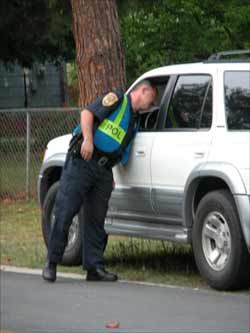
“This includes both approach and where to conduct an interview,” says Corcoran. “The worst place for you to be is bent over into the driver’s side door with your body exposed to passing traffic. You need to get away from the road.”
Approaching the passenger side also gives you a tactical edge, reminds Corcoran. “Most people expect an officer to approach from the driver’s side, so they keep an eye on their rear-view and driver’s door mirrors watching for you. While their focus is distracted, you have a chance to look inside the vehicle to check for weapons and suspicious movement before they even realize you’re there.”
Use your steering wheel as a writing platform.
If you’re writing a ticket while sitting in your driver’s seat, use the wheel as a place to prop your book. “This allows you to quickly glance up at the suspect car to watch for movement and to glance in your interior rear-view mirror [which, he reminds, should be positioned to deflect the sharp glare of oncoming headlights] to keep an eye on oncoming traffic,” says Corcoran. “Granted, you may have mere seconds to react should you see a vehicle headed into yours, but by keeping an eye on oncoming traffic you do increase your odds of spotting a weaving driver from enough of a distance to allow you to take protective action.”
Be prepared for wind.
“A big factor in highway patrol is wind,” says Corcoran. “A truck driving by you at a high rate of speed can generate a lot of wind force. You need to be prepared for that.” If you see a truck coming your way, be sure your footing is stabilized to prevent being blown off balance. “The same is true of cars,” Corcoran continues. “Be sure of your footing and be aware that you’re going to need to ride the wind a bit.”
Resist retrieval.
“Another issue with highway wind is having your hat blown off, if you’re required to wear one, or having paperwork blown out of your hands,” says Corcoran. “A natural reaction is to quickly move to grab it. On the side of a road, this can be a fatal mistake.” Be mentally prepared to resist the reflex to step out into traffic or bend over to retrieve something that has blown out of your hands or off your head.
Consider road conditions.
Wet, slippery roads increase roadside risks. “Although you must always remain intensely observant of your surroundings and vigilant to sound positioning, you should be particularly alert during bad weather,” says Corcoran. “In slippery conditions, you need to weigh the necessity of getting out of your vehicle,” he says. “If you’re approaching a breakdown situation, use your PA to see if the car is able to be move to a safe location, even if it’s limping, or if you can move it with your patrol unit. Stepping out of your car in conditions where passing vehicles may slide into you poses risks that if at all possible, are best avoided.”